Wednesday, November 25, 2009

Mixed bag, from Barry Zimmer

Barry Zimmer sends in the highlights of three Panama tours led on October and November.


Blue-footed Booby - 100+ off Costa del Este (east of Panama City) October 19 feeding very close to shore; more impressive was more than a thousand along the beaches (and covering an offshore island) off Santa Clara and near Juan Hombrón November 12

Swallow-tailed Kite - two from the Canopy Tower October 18 seemed very late. I have not seen them here in October before.

Sharp-shinned Hawk - one at the Canopy Lodge in El Valle November 8 was the first I have seen in that area of Panama

Collared Plover - pair at Panama Viejo October 23; only my second for Panama


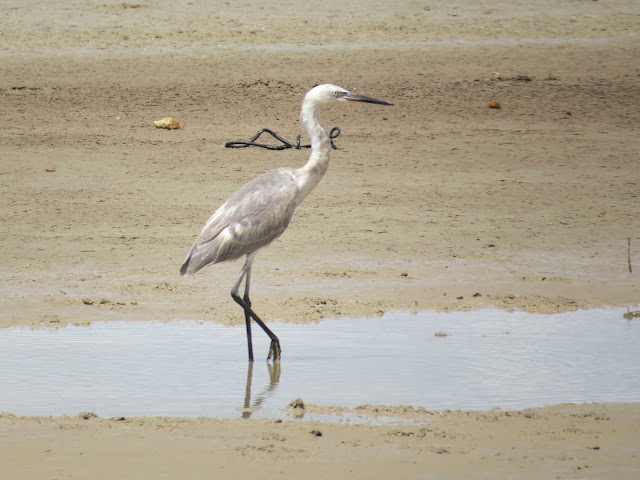
Long-billed Curlew - one found and photographed at Panama Viejo October 23; this is the third or fourth time I have seen one at this location in the last ten years (maybe the same bird coming back to winter each time?); attached photo

Black-billed Cuckoo - one seen on La Mesa above El Valle October 25; only my second in Panama

Touit species - a group of four Touit parrotlets came low right overhead on Los Altos del María on October 26. From the view I had I could not distinguish which species as I was either looking straight up or at the flock going away so I could not see the head clearly, However my co-leader Danilo Rodriguez says that only Blue-fronted has ever been documented in this region of Panama, so I am assuming that is what they were.

Spot-crowned Barbet - three just above the Canopy Lodge on November 8 were my first for that location; also had a pair at Cerro Azul October 19 and another pair at Achiote on October 21 (more expected locales).

Rufous-browed Tyrannulet - one on Altos del María November 11.


Rose-throated Becard - one female found and photographed just outside of El Valle on the Las Mozas trail November 10. I am guessing this is a fairly significant record as Danilo had never seen them there before and Ridgely indicates only records for the Chiriquí region. Even given that the species has expanded in Chiriquí I would think this could be a southernmost (easternmost?) record.

House Sparrow - we had a pair in Panama City on October 23 which were my first for that city. I had previously only seen them around Colon, but perhaps they have now spread into Panama City with regularity.

Juvenile Sabine's Gull in Costa del Este


Jan Axel Cubilla photographed this small gull in Costa del Este on Friday, November 20. The bird was noticeably smaller than the Laughing Gulls around it, with a thinner bill and a more delicate shape, plus it was browner on the hind neck and back and whiter below. Based on these differences (and on the white skirt of the secondaries and the black primaries) we are calling this a juvenile Sabine's Gull. If we squint we can even see the scaly back.


Monday, November 23, 2009

Wandering Tattler in Coiba


Rafael Luck and Euclides Campos found this Wandering Tattler (of the adult non-breeding denomination) on Coiba National Park's Granito de Oro beach, on November 21. Seen teetering like a Spotted Sandpiper, but larger and longer-billed. The photos show the typical tattler jizz, halfway from Spotted Sandpiper to Willet, with a horizontal stance and attenuated silhouette. Notice also the medium bill, distinct facial pattern (dark lores, pale supraloral, white eye crescents), and short, yellowish legs.


Blackpoll Warbler in Cerro Azul, a report by Bill Adsett

Yesterday (Sunday) there was a male Blackpoll Warbler in non-breeding plumage at the house in Cerro Azul. The distinguishing features were lemon-yellow breast, otherwise white underparts (including tail); quite heavy dusky streaking on sides; yellowish eyebrow above dusky stripe through eye; crown and back olive green, heavily streaked dusky; white wingbars; no chestnut or buffy coloring on sides. It was subtly but clearly different from the non-breeding Bay-breasted warblers we are so familiar with. No photos, I'm afraid. I used Curson, Quinn and Beadle's New World Warblers to confirm the identification.

Green Thorntails still in Cerro Azul


Yesterday evening, Jan Axel Cubilla and Gloriela Archbold visited Birders' View in Cerro Azul in search of Green Thorntails, and they saw three: a male, a female, and a female-plumaged bird with a long tail (a young male, perhaps). Also seen were nine other species of hummingbird, including Violet-headed and Violet-capped, and tanagers galore. More photos and details are over at Jan Axel's Blog.

Saturday, November 21, 2009

Mixed bag: Crested Owl, Green Thorntails, Wood Storks


  • Bill Adsett forwards this photo of a Crested Owl taken by Javier Araúz, perhaps in the grounds of Petroterminales de Panamá reserve near Puerto Armuelles.
  • Rosabel Miró went to her house in Cerro Azul this morning, and she found a big tree full of flowers above her parking lot that had at least two female and one male Green Thorntail, as well as Violet-capped Hummingbirds.
    Como a las 4:30pm del sábado 21 de noviembre, cuando Karl y yo nos disponíamos regresarnos a la Ciudad, en el estacionamiento de Birders' View, Cerro Azul, observamos unos Green Thorntails, un macho con su cola bien larga y por lo menos dos hembras en un árbol que está justo en el estacionamiento. Este árbol tiene florecitas blancas pequeñas que cuando está en flor, atrae a los Violet-capped Hummigbirds, los Snowy-bellied Hummingbirds y a los Thorntails. Vi varias veces que los Violet-capped y el macho del Thorntail se enfrascaban en lucha pero el Thorntail nunca abandonó el árbol. Por lo general los colibriés más grandes siempre hacen que los más chicos sólo lleguen de paso por el árbol y en esta ocasión me extrañó bastante ver que el Thorntail pelea a la par que un colibrí más grande, no se dejó someter.
  • Charlotte Elton spent her afternoon up in Cerro Ancón watching for the trailing edge of the raptor migration, and she saw a flock of about a hundred Wood Storks circling overhead.

Wednesday, November 18, 2009

Crested Eagle in Nusagandi


A week ago, José Carlos García photographed this dark phase Crested Eagle near the old Cabañas El Jaguar site in Nusagandi. Upon reviewing the photo, Panama Records Committee chair George Angehr points out the following diagnostic field marks:

  • Crested Eagle has a rare all-dark morph. This form is not known to occur in Harpy Eagle. A Harpy should also show a distinct contrasting black chest band.
  • Single pointed crest rather than double.
  • Relatively slender legs and feet, much thinner than Harpy.
  • Rounded rather than squarish tail.
  • It's much too bulky and the crest is too long for Black Hawk-Eagle, which would also have feathered legs.
José Carlos also reports that the Nusagandi refuge is now cleaner than before, with two showers and two flushing toilets. Food-wise, there is a small fonda before Burbayar that's open for breakfast and lunch.

Tuesday, November 17, 2009

Mystery hummingbird at Cerro Punta, a report by Jan Axel Cubilla


Jan Axel Cubilla and Gloriela Archbold spent the weekend in Cerro Punta looking for Peg-billed Finch, which remained elusive. On the 15th, they saw this mystery hummingbird in the grounds of Hotel Los Quetzales in Guadalupe. ¿What do you think it is?
El domingo 15, mientras tomaba fotos en los alrededores del Hotel Los Quetzales en Guadalupe, observe un colibrí pequeño (de igual tamaño que un Scintillant Hummingbird o ligeramente más grande). Como no le vi nada de rufo al principio, pensé en un Volcano Hummingbird; sin embargo, al revisar y aumentar las fotos noté la ausencia total de rufo en la cola (a ciencia cierta no puedo distinguir que tuviera blanco, pareciera que no). No tenía rufo en las alas tampoco. Es completamente blanca por debajo, sin pintas en la garganta y sin cambio de color en los flancos, con una pequeña pinta post-ocular blanca. Ambos Selasphorus tienen rufo en la cola y tienen una forma más rechoncha... la ausencia de marcas en la rabadilla descartan coquetas y a la Magenta-throated Woodstar, comparables en tamaño. La hembra del Violet-bellied Hummingbird y de la Violet-crowned Woodnymph no se esperan a esa altitud... esta última tiene dos tonos en las partes ventrales y la primera no se conoce en Panamá occidental. El Sapphire-throated Hummingbird es más grande y tampoco se espera a esa altitud. Me parece que es una hembra de Ruby-throated Hummingbird. Alguna opinión?
[And we agree, even if this winter visitor usually sticks to the lowlands. —Ed.]
[UPDATE: Venicio Wilson tells us he's seen Ruby-throated Hummingbirds in Volcán, and his formerfieldeditorshipness Dodge Engleman thinks this also looks like a female Ruby-throated. Case closed.]

El sábado 14 observamos en Cuesta de Piedra un Buff-throated Foliage-Gleaner y un Riverside Wren en los alrededores del río Macho de Monte. Me parece que, aunque no son inesperados, se reportan pocos desde Chiriquí.

Friday, November 13, 2009

Long-winged Harrier in El Real, a report by Euclides Campos


Durante los días patrios decidí ir con unos amigos a visitar el Real y Rancho Frío. El jueves 5 de noviembre, fui al airstrip en la mañana donde me tropecé con este harrier. Este individuo era bien oscuro con algunas rayas blancas por debajo. De acuerdo a la literatura, el juvenil dark morph Long-winged Harrier es todo dark brown y poseen rufous thighs. En una de las fotos se puede ver algo los rufous thighs. Los juveniles northern harrier son oscuros en el chest y luego twany el resto.
En rancho frío vimos Double-banded Graytail, Wing-banded Antbird, Yellow-backed Tanager, Scarlet-browed Tanager, Sapayoa, Black-and-white Hawk-Eagle, Ornate Hawk-Eagle, Plumbeous Hawk y Tawny-faced Quail.


Wednesday, November 4, 2009

Live from Cerro Punta

All week we will be on location in Cerro Punta an environs investigating the reports of seeding bamboo and hoping to run into those pesky seeding bamboo followers: Peg-billed Finch, Barred Parakeet, and Maroon-chested Ground-Dove. Since blogger's iPhone interface sucks (i.e. It doesn't have one), we will be posting mostly on Twitter. @xenornis. Go ahead, follow us.
But here's what we have so far: yesterday morning I walked up to the grounds of Los Quetzales cabins and found two big patches of bamboo. The first one was completely devoid of birds, but the second had a flock of at least four Peg-billed Finches, foraging and calling. No adult males were seen, just female-plumaged birds. Also seen were Green-fronted Lancebill and Scaly-throated Foliage-Gleaner (shamebird no more). Today I went with Jan Axel Cubilla and Gloriela Archbold to PILA Las Nubes, where we found lots of bamboo but no bamboo followers. After lunch, and after Jan Axel and Gloriela had headed back to civilization, I walked up towards the waterfall, where the only noteworthy event was a flock of Barred Parakeets calling from the mist above the canopy (heard only, sadly enough). The town of Las Nubes had a flock of about 50 Crimson-fronted Parakeets, which may or may not be noteworthy.

Sites mentioned